Technology Support and Maintenance Services
Protect your digital assets with proactive technology support and maintenance services built for uptime, security, and growth.
Protect your digital assets with proactive technology support and maintenance services built for uptime, security, and growth.
Serving enterprises, startups, and mid-market businesses across North America, Europe, Asia-Pacific, and the Middle East with round-the-clock technology support.


Every minute of unplanned downtime costs revenue, erodes customer trust, and disrupts operations. Legacy systems grow fragile. Security vulnerabilities multiply. Internal teams, already stretched across strategic projects, struggle to keep pace with patching cycles, performance tuning, and infrastructure monitoring. The challenge is not just fixing what breaks; it is preventing breakdowns before they reach your end users.
TAV Tech Solutions delivers managed technology support and maintenance services that combine proactive monitoring, SLA-driven incident resolution, and continuous optimization. From application support and maintenance to cloud infrastructure management, the approach blends AI-powered diagnostics with certified engineering talent. The result is measurable: higher uptime, lower total cost of ownership, and IT operations that scale alongside your business priorities.




Keep business-critical applications stable with L1, L2, and L3 support tiers covering bug resolution, performance tuning, and feature enhancements. Structured SLAs ensure rapid incident response, reducing mean time to repair and safeguarding user productivity across web, mobile, and enterprise platforms.

Maintain peak performance on AWS, Azure, and Google Cloud through automated monitoring, resource optimization, and proactive patch management. Scheduled maintenance windows, capacity planning, and cost governance help you extract maximum value from cloud investments without service disruption.
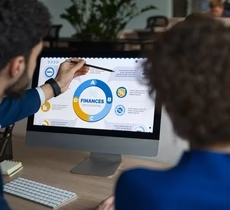
Banks and financial institutions face stringent regulatory requirements alongside zero-tolerance uptime expectations. Technology support and maintenance services ensure transaction processing platforms, fraud detection engines, and digital banking applications remain compliant, secure, and performant. Proactive monitoring detects anomalies in payment gateways before they affect customer transactions. Regular patching cycles close vulnerabilities mandated by PCI DSS and SOX regulations.

Electronic health record systems, telemedicine platforms, and clinical research applications demand uninterrupted availability. IT support and maintenance services protect patient data integrity through HIPAA-aligned security patching and backup verification. Predictive maintenance prevents equipment interface failures that could delay diagnostics. Ongoing application support ensures seamless integrations between laboratory systems, pharmacy networks, and patient portals.
Banks and financial institutions face stringent regulatory requirements alongside zero-tolerance uptime expectations. Technology support and maintenance services ensure transaction processing platforms, fraud detection engines, and digital banking applications remain compliant, secure, and performant. Proactive monitoring detects anomalies in payment gateways before they affect customer transactions. Regular patching cycles close vulnerabilities mandated by PCI DSS and SOX regulations.
Electronic health record systems, telemedicine platforms, and clinical research applications demand uninterrupted availability. IT support and maintenance services protect patient data integrity through HIPAA-aligned security patching and backup verification. Predictive maintenance prevents equipment interface failures that could delay diagnostics. Ongoing application support ensures seamless integrations between laboratory systems, pharmacy networks, and patient portals.
Certified engineers delivering enterprise-grade support across platforms, clouds, and frameworks with measurable SLA performance.
Certified architects managing workloads across AWS, Azure, and GCP with Infrastructure-as-Code automation, cost optimization dashboards, and cross-cloud failover strategies. Expertise spans compute, storage, networking, serverless, and container orchestration with Kubernetes and ECS.
Deep experience supporting SAP, Oracle E-Business Suite, Microsoft Dynamics, Salesforce, and custom-built enterprise platforms. Services include configuration management, release coordination, regression testing, and performance benchmarking against SLA-defined thresholds.
Security operations covering SIEM management, endpoint detection and response, vulnerability assessments, and penetration testing. Compliance-aligned support for GDPR, HIPAA, PCI DSS, SOC 2, and ISO 27001 ensures audit readiness. Incident response playbooks reduce mean time to containment.
Production-grade support for relational and NoSQL databases including SQL Server, PostgreSQL, MySQL, Oracle, MongoDB, and DynamoDB. Services span performance tuning, replication management, automated backup verification, disaster recovery testing, and migration planning.
SRE-aligned operational practices using Terraform, Ansible, Jenkins, GitLab, and ArgoCD. Expertise includes toil reduction, error budget management, chaos engineering, and observability stack maintenance with Prometheus, Grafana, ELK, and Datadog.
Deploying machine learning models for anomaly detection, event correlation, and automated root cause analysis. AIOps platforms reduce alert noise by up to 90%, accelerate incident triage, and enable predictive capacity planning that prevents outages before they materialize.
Nine measurable advantages that set our technology support and maintenance services apart from conventional providers.
TAV Tech Solutions has earned several awards and recognitions for our contribution to the industry


No posts found.
This guide helps CTOs, IT directors, and procurement leaders evaluate, select, and optimize technology support and maintenance services for their organizations.
Begin by mapping existing support processes against industry frameworks such as ITIL and COBIT. Identify recurring incident categories, average resolution times, and total cost of downtime. Benchmark your current mean time to repair against industry medians for your sector. This baseline reveals whether internal capabilities meet operational demands or whether managed IT maintenance represents a stronger path to stability and scale.
In-house support provides direct control but carries fixed headcount costs, training overhead, and attrition risk. Outsourced technology support and maintenance services deliver elastic capacity, broader skill coverage, and contractual accountability. Hybrid models, where strategic functions remain internal while routine operations are outsourced, often yield the best balance of control and efficiency for mid-market and enterprise organizations.
Not every system requires the same response urgency. Map applications to business impact tiers. Revenue-generating platforms merit aggressive SLAs with 15-minute acknowledgment and 4-hour resolution targets. Internal productivity tools may require standard business-hours coverage. Tiered SLA structures optimize cost without compromising protection for critical assets. Ensure SLAs include uptime guarantees, escalation protocols, and penalty clauses.
Shortlist providers based on certifications, industry references, and technical depth. Request case studies that demonstrate measurable outcomes, not generic capability decks. A credible IT maintenance and support provider will demonstrate communication cadence, reporting transparency, and willingness to integrate with your existing toolchains. Cultural alignment in areas such as urgency handling, documentation rigor, and continuous improvement mindset is often the differentiator between adequate and exceptional partnerships.
A strong support partner does more than maintain the status quo. Evaluate whether the provider offers modernization pathways, including legacy system stabilization, cloud migration support, and architecture advisory services. Technology support and maintenance should serve as a bridge toward your future-state architecture, not an anchor to outdated platforms. Roadmap alignment between your transformation goals and the provider strategy is essential.
Establish KPIs that connect support metrics to business outcomes. Track cost-per-ticket, first-contact resolution rate, system availability, and incident recurrence trends. Monthly executive dashboards should translate operational data into financial impact. Governance frameworks with quarterly business reviews ensure the partnership evolves alongside your technology estate and business objectives. Continuous feedback loops drive sustained value delivery.
A standard engagement covers incident management, proactive monitoring, security patching, performance optimization, backup verification, and scheduled maintenance. Scope is tailored to your technology stack and business priorities, with clear SLAs defining response and resolution commitments. Choosing a proven software support and maintenance company ensures consistent delivery aligned to your operational needs.
Support follows a tiered model. L1 handles basic troubleshooting and ticket triage. L2 addresses configuration issues, application errors, and system diagnostics. L3 provides deep engineering support for complex infrastructure problems, code-level fixes, and architecture advisory. Each tier has defined escalation protocols and SLA targets.
Let’s connect and build innovative software solutions to unlock new revenue-earning opportunities for your venture


We would love to hear from you

5th Floor, DLF Two Horizon Centre, DLF Phase 5, Gurugram, HR 122002


