NodeJS Support and Maintenance Services
Keep your Node.js applications secure, performant, and production-ready with proactive monitoring, expert troubleshooting, and dedicated maintenance engineers.
Keep your Node.js applications secure, performant, and production-ready with proactive monitoring, expert troubleshooting, and dedicated maintenance engineers.
Delivering reliable nodejs support and maintenance services to enterprises and startups across North America, Europe, Asia-Pacific, and the Middle East.


Production Node.js systems demand continuous attention. Outdated npm dependencies, memory leak detection failures, unpatched security vulnerabilities, and aging runtime versions create compounding risks. Without structured nodejs application support, event loop bottlenecks and unhandled exceptions degrade user experience, erode revenue, and expose sensitive data to attackers targeting known CVEs in end-of-life releases.
TAV Tech Solutions provides end-to-end nodejs support and maintenance services that cover nodejs performance optimization, proactive nodejs server monitoring, express.js maintenance, and scheduled nodejs version upgrade services. Our dedicated nodejs maintenance team applies nodejs security patching, manages npm dependency management lifecycles, and conducts regular nodejs application health check routines so your real-time application support needs are met around the clock.




Rapid root-cause analysis and resolution for runtime exceptions, unhandled promise rejections, middleware conflicts, and data-layer errors. Our nodejs bug fixing protocols restore production stability within defined SLA windows, minimizing revenue impact and safeguarding end-user trust in your platform.

Identify and eliminate CPU-bound blocking calls, inefficient database queries, and excessive garbage collection pauses. Our nodejs performance optimization service uses profiling tools like Clinic.js and Node Inspector to reclaim throughput, reduce latency, and cut infrastructure costs for high-traffic systems.

Seamlessly migrate from deprecated or end-of-life runtime versions to the latest Active LTS release. Our nodejs version upgrade services include compatibility audits, automated regression testing, and staged rollouts that ensure zero-downtime transitions and full compliance with upstream security advisories.

Guard your backend against known CVEs, prototype pollution attacks, and supply-chain vulnerabilities embedded in transitive packages. Our nodejs security patching workflows integrate with CI/CD pipelines to automate patch verification and deployment, keeping your attack surface narrow and your compliance posture strong.

Audit, update, and lock third-party packages to prevent version drift, licensing conflicts, and phantom dependency exploits. Effective npm dependency management reduces build-time failures, shrinks container images, and guarantees reproducible deployments across development, staging, and production environments.

Continuous observability for CPU utilization, heap memory consumption, event loop lag, and request throughput. Our nodejs server monitoring dashboards leverage Datadog, Prometheus, and Grafana to surface anomalies in real time, enabling rapid incident response before service degradation reaches end users.
Diagnose and resolve blocked or starved event loop conditions caused by synchronous file I/O, heavy JSON serialization, or compute-intensive middleware. Event loop optimization restores non-blocking concurrency, improves request-per-second capacity, and ensures consistent sub-100ms response times under heavy load.

Heap snapshots, allocation timelines, and garbage collection profiling expose hidden memory leaks that silently inflate RAM usage. Our nodejs memory leak detection methodology pinpoints leaked closures, detached DOM references in server-side rendering, and unbounded caches that lead to out-of-memory crashes.

Versioned endpoint upkeep, schema validation hardening, and rate-limiter tuning for RESTful and GraphQL interfaces. Reliable nodejs API maintenance ensures backward compatibility, reduces breaking-change incidents, and maintains third-party integration health for connected mobile apps and partner ecosystems.

Middleware audit, route optimization, and template engine updates for Express-based backends. Our express.js maintenance service addresses deprecation warnings, CORS misconfiguration, and session management vulnerabilities to keep the most widely deployed Node.js framework running securely and efficiently.

Socket.IO, WebSocket, and Server-Sent Events channel management for chat platforms, live dashboards, and collaborative editing tools. Real-time application support covers connection scaling, reconnection logic, and backpressure handling to maintain low-latency message delivery at enterprise concurrency levels.

Structured transition planning from Maintenance LTS or EOL releases to the current Active LTS branch. Our nodejs LTS migration process includes ecosystem compatibility scanning, native add-on rebuild verification, and rollback strategies that protect business continuity during runtime transitions.

Failover configuration, automated backup scheduling, and recovery runbook design for mission-critical Node.js deployments. Nodejs disaster recovery planning ensures your application can resume operations within defined recovery-time objectives following infrastructure failures, data corruption, or security breaches.

Architectural assessment, anti-pattern identification, and refactoring recommendations from senior engineers. Our nodejs code review services evaluate error handling strategies, async control flow patterns, and test coverage gaps to improve long-term maintainability and reduce technical debt.

Trading platforms and payment gateways built on Node.js handle millions of concurrent transactions. Nodejs uptime monitoring and proactive nodejs security patching protect against latency spikes and regulatory compliance breaches. SLA-based nodejs support ensures every millisecond counts during market hours.
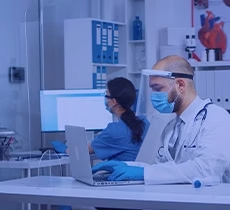
Telehealth portals, patient scheduling APIs, and electronic health record integrations require strict data integrity. Nodejs application support maintains HIPAA-compliant environments through encrypted data flows, access log auditing, and continuous nodejs server monitoring for anomaly detection.

Product catalog APIs, cart services, and checkout flows must stay responsive during traffic surges. Nodejs performance optimization eliminates abandoned-cart scenarios, while event loop optimization sustains sub-second page loads during flash sales and seasonal peaks.

Video streaming backends, content delivery APIs, and real-time recommendation engines rely on non-blocking I/O. Real-time application support and nodejs memory leak detection prevent buffering interruptions that drive subscriber churn and damage brand perception.

Fleet tracking dashboards, warehouse management APIs, and shipment notification services demand continuous availability. Nodejs disaster recovery and npm dependency management keep logistics platforms operational across global time zones without data synchronization failures.

Virtual classrooms, assessment platforms, and learning management system APIs serve thousands of concurrent learners. Nodejs bug fixing resolves session timeout errors and WebSocket disconnections, while nodejs code review services improve long-term platform scalability.

Multi-tenant architectures, webhook processing pipelines, and integration middleware built with Node.js need ongoing maintenance. Nodejs API maintenance and express.js maintenance ensure tenant isolation, rate limiting accuracy, and backward-compatible releases for partner ecosystems.

Booking engines, pricing aggregation services, and guest experience portals depend on reliable backend orchestration. Nodejs version upgrade services and nodejs application health check routines ensure peak-season readiness and prevent revenue loss from system outages.

Network management dashboards, subscriber analytics APIs, and real-time billing engines process enormous event volumes. Nodejs troubleshooting services and nodejs managed support services resolve high-throughput bottlenecks and maintain carrier-grade service reliability.

Claims processing APIs, underwriting calculators, and policy management portals require audit-trail compliance. Outsource nodejs support to access expertise in secure session management, input validation hardening, and continuous nodejs uptime monitoring for regulatory readiness.
Trading platforms and payment gateways built on Node.js handle millions of concurrent transactions. Nodejs uptime monitoring and proactive nodejs security patching protect against latency spikes and regulatory compliance breaches. SLA-based nodejs support ensures every millisecond counts during market hours.
Telehealth portals, patient scheduling APIs, and electronic health record integrations require strict data integrity. Nodejs application support maintains HIPAA-compliant environments through encrypted data flows, access log auditing, and continuous nodejs server monitoring for anomaly detection.
TAV Tech Solutions brings deep runtime-level knowledge refined through hundreds of production Node.js engagements across diverse industries and geographies.
Deep understanding of V8 internals, libuv thread pool mechanics, and garbage collection tuning. We apply this knowledge during nodejs performance optimization and event loop optimization to extract maximum throughput from every production instance, reducing infrastructure spend while increasing request capacity.
Hands-on expertise across Express.js, NestJS, Fastify, Koa, and Hapi. Our express.js maintenance capabilities extend to middleware refactoring, dependency injection patterns, and structured logging integration. This framework fluency accelerates nodejs bug fixing and shrinks mean-time-to-resolution for complex issues.
OWASP-aligned vulnerability assessments, supply-chain audit tooling (Snyk, Socket.dev), and automated nodejs security patching pipelines. We harden authentication flows, enforce content security policies, and implement rate limiting to protect APIs from abuse and ensure compliance with SOC 2, GDPR, and HIPAA requirements.
Full-stack observability using OpenTelemetry, Prometheus, Grafana, and Datadog integrations. Our nodejs server monitoring and nodejs uptime monitoring practices establish baselines, detect anomalies, and trigger automated escalation workflows that minimize mean-time-to-detect and mean-time-to-recover.
Automated testing gates, canary deployments, and blue-green release pipelines for Node.js workloads on AWS, Azure, and GCP. Nodejs version upgrade services and npm dependency management are embedded within deployment workflows to prevent regressions and enforce quality gates before production promotion.
Microservices decomposition, horizontal scaling strategies, and container orchestration guidance for Kubernetes-hosted Node.js services. Nodejs code review services evaluate architectural decisions, identify coupling risks, and recommend event-driven patterns that improve fault tolerance, observability, and long-term maintainability.
Proven reliability, engineering depth, and client-centric delivery make us the right long-term partner.
TAV Tech Solutions has earned several awards and recognitions for our contribution to the industry


No posts found.
Choosing the right partner for nodejs support and maintenance services is a strategic decision that directly impacts application uptime, security posture, and total cost of ownership. This guide equips CTOs, VPs of Engineering, and IT procurement leaders with the evaluation framework needed to compare providers, assess service depth, and negotiate contracts that protect long-term business interests.
Begin by mapping every Node.js workload in your portfolio: API gateways, background job processors, real-time communication services, server-side rendering layers, and scheduled task runners. For each workload, document the runtime version, framework dependencies, hosting environment, and criticality tier. This inventory determines whether you need reactive nodejs troubleshooting services for a handful of low-risk utilities or comprehensive nodejs managed support services covering mission-critical revenue systems. Providers who offer tiered packages aligned to workload criticality deliver better cost efficiency than those offering one-size-fits-all plans. Clarify upfront whether the scope includes nodejs bug fixing only, or extends to nodejs performance optimization, nodejs security patching, nodejs version upgrade services, and npm dependency management. Ambiguity in scope is the primary driver of disputes in long-term support contracts.
A credible nodejs application support partner should demonstrate expertise beyond surface-level Express.js routing. Ask for evidence of event loop optimization engagements, nodejs memory leak detection case studies, and nodejs LTS migration project histories. Request CVs of engineers who will be assigned to your account and verify their familiarity with your framework stack, whether that is NestJS, Fastify, Koa, or a custom architecture. Evaluate their observability maturity: do they operate nodejs server monitoring with structured tracing (OpenTelemetry) and dashboard-driven alerting, or rely on basic log tailing? Providers with nodejs code review services embedded in their maintenance workflow deliver higher-quality outcomes because they identify systemic issues rather than repeatedly patching symptoms.
SLA-based nodejs support must define four critical metrics: initial response time, time-to-diagnosis, time-to-resolution, and post-incident review cadence. Demand tiered severity definitions with explicit escalation paths. Severity-1 incidents should trigger immediate war-room mobilization, not a queued ticket. Review penalty clauses: credible providers offer service credits for missed SLAs. Examine how the provider handles nodejs disaster recovery scenarios. Ask for documented runbooks, recovery-time objectives, and evidence of tested failover procedures. A partner who treats SLAs as marketing copy rather than contractual obligations will underperform when production pressure is highest.
Node.js applications face a unique threat landscape due to the npm ecosystem’s depth and transitive dependency chains. Evaluate whether the provider performs automated nodejs security patching on a defined cadence or only reacts to disclosed CVEs. Ask how they handle zero-day vulnerabilities in popular packages. Review their npm dependency management process: do they use lock files, integrity checks, and allow-list policies? For regulated industries, confirm compliance support for SOC 2, HIPAA, GDPR, and PCI-DSS. A mature provider will maintain audit-ready documentation, conduct periodic penetration testing, and integrate security gates into CI/CD pipelines. Security is not an add-on; it is a baseline requirement for any nodejs support and maintenance services engagement.
Nodejs support pricing varies significantly by engagement model. Common structures include per-incident billing, monthly retainer hours, dedicated team allocation, and outcome-based contracts tied to uptime or performance KPIs. When you hire nodejs support engineers on a retainer, negotiate for unused-hour rollover provisions. For organizations considering whether to outsource nodejs support, compare fully loaded costs against internal hiring: factor in recruitment, training, tool licensing, on-call compensation, and attrition risk. A dedicated nodejs maintenance team from an external provider often delivers 30 to 40 percent cost savings while providing broader skill coverage. Request transparent pricing breakdowns that separate labor, tooling, and infrastructure monitoring costs.
The best partnerships are built on transparency, including the freedom to leave. Evaluate the provider’s onboarding process: do they conduct architecture discovery sessions, create runbook documentation, and establish shared knowledge bases? During the engagement, insist on monthly knowledge-transfer sessions where internal teams receive training on resolved incidents, optimization techniques, and monitoring configurations. Define exit terms before signing: intellectual property ownership, documentation handover timelines, transition support duration, and data deletion policies. Providers confident in their value will not lock you into opaque processes or proprietary tooling that creates switching costs. Your nodejs application health check reports, monitoring dashboards, and incident databases should remain accessible regardless of contract status.
Our nodejs support and maintenance services cover nodejs bug fixing, nodejs performance optimization, nodejs security patching, nodejs version upgrade services, npm dependency management, nodejs server monitoring, nodejs application health check routines, and 24/7 incident response. Each engagement is tailored to your application portfolio’s complexity and criticality requirements.
Under our SLA-based nodejs support agreements, Severity-1 incidents receive sub-30-minute acknowledgment and immediate war-room mobilization. Severity-2 issues are acknowledged within two hours. All response and resolution targets are contractually defined with service-credit penalties for missed commitments.
Yes. Our express.js maintenance services extend to NestJS, Fastify, Koa, Hapi, and custom Node.js architectures. We assess your framework stack during onboarding and assign engineers with specific expertise in your technology choices to ensure effective nodejs troubleshooting services from day one.
Our nodejs version upgrade services begin with a compatibility audit that maps every dependency against the target LTS release. We execute staged rollouts in non-production environments, run automated regression suites, and monitor production canary deployments before completing the migration. Nodejs LTS migration follows the same disciplined approach.
We operate automated vulnerability scanning integrated into your CI/CD pipeline. When new CVEs affect your dependency tree, our nodejs security patching workflow validates the fix, tests for breaking changes, and deploys the patch within the SLA-defined window. Critical zero-day patches receive immediate priority escalation.
Absolutely. Our hire nodejs support engineers model offers full-time dedicated professionals embedded in your workflows. You retain direct communication access, sprint planning involvement, and code-commit visibility. Dedicated engineers participate in standups, retrospectives, and architecture reviews alongside your internal team.
Npm dependency management includes automated audits for known vulnerabilities, license compliance checks, version pinning with lock-file enforcement, and transitive dependency analysis. We produce monthly reports identifying outdated packages, deprecated libraries, and recommended upgrade paths to maintain a healthy dependency tree.
We capture heap snapshots at defined intervals, analyze allocation timelines, and profile garbage collection behavior. Nodejs memory leak detection identifies leaked closures, detached references in server-side rendering contexts, and unbounded cache growth. Findings are documented with remediation steps and verified through post-fix memory regression testing.
Our nodejs server monitoring stack includes Prometheus for metrics collection, Grafana for dashboard visualization, Datadog for APM tracing, and OpenTelemetry for distributed trace propagation. We configure alerts for CPU utilization, heap consumption, event loop lag, and request error rates tailored to your baseline thresholds.
Yes. Our standalone nodejs application health check is a comprehensive assessment covering runtime version status, dependency vulnerability exposure, event loop optimization opportunities, memory consumption patterns, and API endpoint performance. You receive a detailed report with prioritized recommendations and estimated effort for each remediation item.
Event loop optimization identifies synchronous blocking operations, heavy JSON serialization routines, and compute-intensive middleware that starve the loop. By refactoring these into asynchronous workers or offloading to child processes, we restore non-blocking concurrency and significantly improve request throughput and response latency.
Our nodejs uptime monitoring uses synthetic probes, real-user monitoring, and infrastructure health checks to validate availability from multiple global locations. Downtime alerts trigger automated escalation workflows. Monthly availability reports track SLA adherence and highlight maintenance windows that contributed to planned downtime.
Yes. Outsource nodejs support engagements are available for project-based needs such as major version migrations, post-launch stabilization periods, or seasonal traffic surge preparation. Short-term contracts include full onboarding, knowledge transfer, and documented handover upon completion.
Nodejs disaster recovery covers automated backup scheduling, failover architecture design, recovery runbook creation, and periodic recovery drills. We define recovery-time and recovery-point objectives aligned to your business continuity requirements and test procedures quarterly to ensure readiness.
Nodejs code review services include architectural assessment, error-handling pattern evaluation, async control-flow analysis, and test coverage gap identification. Senior engineers provide annotated feedback with refactoring recommendations. Reviews can be scheduled as recurring quarterly audits or triggered before major releases.
Nodejs managed support services are offered as monthly retainer packages, annual contracts with dedicated team allocation, or outcome-based engagements tied to uptime and performance KPIs. Each model includes defined scope, SLA commitments, and transparent reporting. Retainer clients benefit from unused-hour rollover provisions.
Real-time application support for WebSocket, Socket.IO, and SSE-based systems includes connection pool management, reconnection logic tuning, and backpressure handling. We monitor concurrent connection counts, message delivery latency, and reconnection rates to maintain reliable low-latency communication at enterprise scale
Nodejs support pricing depends on application count, criticality tier, required response times, and chosen engagement model. We offer per-incident packs starting at defined hourly rates, monthly retainers with bundled hours, and dedicated nodejs maintenance team allocations. Contact us for a customized quote based on your portfolio assessment.
Our dedicated nodejs maintenance team operates as an extension of your engineering organization. We use your preferred communication tools, participate in sprint ceremonies, follow your branching and deployment conventions, and maintain shared documentation repositories. Integration timelines typically range from five to ten business days.
Our nodejs troubleshooting services combine deep V8 runtime expertise with full-stack observability tooling. Engineers perform systematic root-cause analysis using distributed tracing, heap profiling, and event loop diagnostics rather than trial-and-error patching. Every resolved incident produces a documented post-mortem with preventive recommendations.
Let’s connect and build innovative software solutions to unlock new revenue-earning opportunities for your venture


We would love to hear from you

5th Floor, DLF Two Horizon Centre, DLF Phase 5, Gurugram, HR 122002


