Kubernetes Support and Maintenance Services
Resilient Kubernetes support and maintenance services that keep clusters secure, scalable, observable, and cost-efficient for mission-critical workloads globally.
Resilient Kubernetes support and maintenance services that keep clusters secure, scalable, observable, and cost-efficient for mission-critical workloads globally.
We deliver Kubernetes managed services worldwide, helping enterprises across regions run reliable, compliant container platforms at any scale.


Running containers at scale is harder than launching them. Teams struggle with version drift, certificate renewals, node failures, noisy alerts, and rising cloud bills. Without dedicated Kubernetes production support, incidents escalate and release velocity slows. Business leaders need a partner who keeps clusters healthy while engineers focus on shipping features.
TAV Tech Solutions delivers Kubernetes support and maintenance services built around SRE principles, proven runbooks, and round-the-clock coverage. Our engineers handle upgrades, patching, autoscaling, observability, and incident response across AWS EKS, Azure AKS, GKE, and on-premise clusters. Outcomes include higher uptime, faster deployments, lower infrastructure spend, and fewer late-night pages for your internal teams.




Full lifecycle Kubernetes cluster management services covering provisioning, node pools, networking, and configuration. We standardize clusters across environments so teams get consistent performance and security without reinventing operational processes for each new workload or region.

Round-the-clock Kubernetes 24/7 support with defined SLAs, incident response, and escalation paths. Engineers monitor clusters continuously, resolve control plane issues, restart failed workloads, and keep production stable while your teams sleep peacefully.

Managed Kubernetes upgrade services for control planes, worker nodes, and add-ons. We test upgrades in staging, handle API deprecations, and execute rolling updates with zero downtime so clusters stay supported and patched against CVEs.

End-to-end Kubernetes security hardening services including RBAC reviews, pod security standards, image scanning, and admission policies. We align clusters with CIS benchmarks and reduce the attack surface across every namespace and workload.

Implement Kubernetes monitoring and observability using Prometheus, Grafana, Loki, and OpenTelemetry. Dashboards, SLO tracking, and alert tuning give teams clear visibility into golden signals, resource saturation, and application performance across distributed services.

Reduce cloud spend with Kubernetes cost optimization services that right-size requests, enable spot instances, and remove idle resources. We deploy tools like Kubecost and Karpenter to deliver measurable savings without compromising reliability.

Fast Kubernetes troubleshooting services for CrashLoopBackOff errors, networking failures, DNS issues, storage mounts, and ingress problems. Our engineers perform deep root cause analysis and deliver durable fixes, not temporary workarounds that return later.

Expert Kubernetes migration support from legacy VMs, Docker Swarm, or one cloud to another. We refactor manifests, rebuild CI/CD pipelines, and validate workloads so teams move to Kubernetes without surprises or production regressions.

Unified multi-cluster Kubernetes management across regions, clouds, and edge sites. Using GitOps tools like Argo CD and Flux, we enforce consistent policies, secrets, and deployments across dozens of clusters from a single pane of glass.

Robust Kubernetes backup and recovery services with Velero, stateful volume snapshots, and cross-region replication. We test restores regularly so your disaster recovery plan actually works when an outage, ransomware event, or human error strikes.

Professional Kubernetes Helm chart management including chart authoring, versioning, private repositories, and dependency updates. We standardize deployments, simplify rollbacks, and make application packaging predictable across development, staging, and production environments.

| Production Kubernetes service mesh support with Istio, Linkerd, or Cilium. We configure mTLS, traffic splitting, and observability so microservices communicate securely and reliably while platform teams gain fine-grained control over routing. |

Tune HPA, VPA, and Cluster Autoscaler with Kubernetes autoscaling optimization for spiky workloads. We balance responsiveness and cost, preventing over-provisioning while ensuring critical services scale quickly during traffic surges or batch jobs.

Continuous Kubernetes CI/CD pipeline support using Argo CD, Jenkins, GitLab, or GitHub Actions. We maintain GitOps workflows, canary releases, and progressive delivery so deployments become boring, repeatable, and safe across the entire engineering organization.

Precise Kubernetes RBAC configuration with least-privilege roles, service accounts, and namespace isolation. We audit access regularly, integrate OIDC providers, and document permissions so security teams meet compliance audits without slowing developer productivity.

Banks run transaction engines on containers and need zero-downtime operations. Our Kubernetes consulting services help financial institutions meet PCI DSS, isolate payment workloads, and deliver high availability across active-active regions. Regulated clusters stay patched, audited, and ready for real-time fraud detection and open banking APIs.

Hospitals and digital health platforms host EHR systems and imaging workloads on Kubernetes. We harden clusters for HIPAA, encrypt persistent volumes, and enable reliable rollouts for patient-facing apps. Kubernetes disaster recovery services protect clinical data and keep telemedicine sessions running during infrastructure failures.

Online retailers face unpredictable traffic during promotions and holidays. Kubernetes autoscaling optimization, CDN integration, and blue-green deployments keep storefronts responsive during flash sales. We also tune checkout services, reduce latency, and protect clusters from bot attacks that spike compute costs unnecessarily.

Streaming platforms serve millions of concurrent viewers and need elastic compute. We operate transcoding pipelines, edge caches, and recommendation services on Kubernetes, scaling pods dynamically with live viewership. Multi-region clusters ensure smooth playback while Kubernetes cost optimization services keep delivery economics sustainable at global scale.
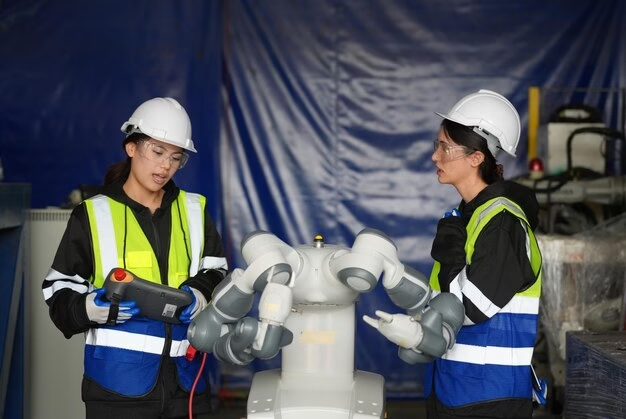
Telecom operators run 5G core functions and OSS/BSS workloads on Kubernetes. We support CNF lifecycle operations, low-latency networking with SR-IOV and Multus, and carrier-grade uptime. Our platform engineering keeps network slices stable while enabling rapid service innovation across metro and edge sites.

Factories deploy Kubernetes at the edge to process sensor data and run predictive maintenance models. We manage lightweight distributions like K3s, handle offline upgrades, and secure device-to-cloud connectivity. Plants gain reliable analytics pipelines without depending on fragile, bespoke on-site scripts or manual interventions.

SaaS providers need multi-tenant isolation, fast onboarding, and predictable scaling. We design namespaces, quotas, and network policies that safely host hundreds of tenants per cluster. Continuous delivery pipelines, feature flags, and progressive rollouts help product teams ship weekly without destabilizing existing customers.
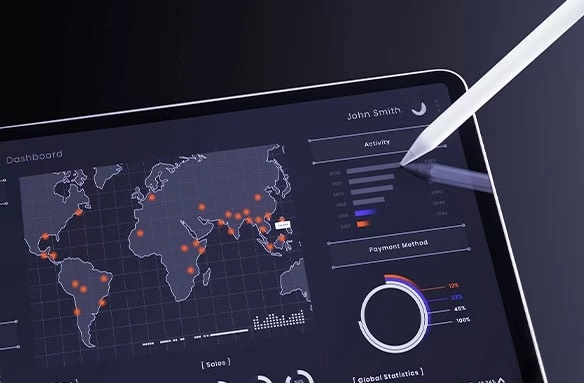
Logistics firms run routing engines, tracking APIs, and warehouse management on distributed clusters. We enable real-time data processing, event-driven architectures with Kafka, and resilient deployments across fulfillment centers. Kubernetes production support keeps shipments flowing even when individual nodes or zones fail unexpectedly.

Energy companies modernize grid analytics and asset monitoring on Kubernetes. We secure OT/IT boundaries, deploy digital twins, and run AI inference close to turbines and substations. Hardened clusters meet NERC CIP standards while enabling faster decisions around generation, distribution, and outage response.

Public agencies migrate citizen services to Kubernetes for scalability and compliance. We implement FedRAMP-aligned controls, air-gapped clusters, and sovereign cloud deployments. Agencies gain modern digital services while keeping sensitive data within approved boundaries and meeting strict audit and accessibility requirements.
Banks run transaction engines on containers and need zero-downtime operations. Our Kubernetes consulting services help financial institutions meet PCI DSS, isolate payment workloads, and deliver high availability across active-active regions. Regulated clusters stay patched, audited, and ready for real-time fraud detection and open banking APIs.
Hospitals and digital health platforms host EHR systems and imaging workloads on Kubernetes. We harden clusters for HIPAA, encrypt persistent volumes, and enable reliable rollouts for patient-facing apps. Kubernetes disaster recovery services protect clinical data and keep telemedicine sessions running during infrastructure failures.
CNCF-aligned engineers with deep experience running production clusters across clouds, hybrid, and edge environments.

We build internal developer platforms on Kubernetes using Crossplane, Backstage, and Argo CD. Our Kubernetes platform engineering practice delivers self-service environments, golden paths, and reusable modules so developers ship faster while platform teams enforce guardrails automatically.
Site reliability engineering for clusters with SLOs, error budgets, toil reduction, and blameless postmortems. Our Kubernetes SRE services stabilize noisy platforms, automate runbooks, and create the operational maturity needed to run containers reliably at enterprise scale every single day.
Deep expertise with Calico, Cilium, Flannel, and cloud-native CNIs. We design network policies, eBPF-based observability, and service meshes that deliver secure east-west traffic, low latency, and clear visibility into how workloads actually communicate inside clusters.
Running databases, message queues, and stateful services on operators like Strimzi, CloudNativePG, and Percona. We handle persistent storage, backup strategies, and failover testing so data-heavy workloads enjoy the same agility as stateless applications without risking data loss.
End-to-end cluster security covering supply chain scanning with Trivy and Cosign, OPA Gatekeeper policies, Falco runtime detection, and CIS benchmarks. We align Kubernetes with SOC 2, ISO 27001, and HIPAA requirements while keeping developer workflows smooth.
Implementing GitOps with Argo CD, Flux, and Flagger. We automate drift detection, canary releases, and rollbacks so every cluster change is auditable, reversible, and driven by pull requests rather than manual kubectl commands in shared terminals.
Unified telemetry using Prometheus, Thanos, Loki, Tempo, and Grafana. We build meaningful dashboards, reduce alert fatigue, and run war rooms during incidents. Post-incident reviews feed back into automation, preventing the same outage from happening twice.
Practical FinOps discipline applied to container platforms. We tag workloads, chargeback by namespace, adopt Karpenter, and move non-critical jobs to spot. Engineering leaders get clear, monthly visibility into where every dollar goes across clusters and cloud accounts.
A trusted Kubernetes partner with CNCF depth, global coverage, and a relentless focus on measurable business outcomes.
TAV Tech Solutions has earned several awards and recognitions for our contribution to the industry


No posts found.
A practical reference for technology leaders evaluating Kubernetes support models, budgets, and partner fit.
If your teams spend more than a quarter of their time firefighting clusters or postponing upgrades, managed support pays for itself. Outsource operational toil so internal engineers can focus on product features, platform innovation, and business-differentiating work instead of recurring incident response.
Options range from hourly expert help, monthly retainers, fully managed services, to embedded SRE pods. Smaller teams benefit from managed services; larger organizations often prefer hybrid models that keep strategy in-house while outsourcing run operations and twenty-four-seven coverage.
Kubernetes support pricing reflects cluster count, workload criticality, compliance requirements, and SLA tier. Transparent partners offer fixed monthly fees with clearly defined inclusions. Budget additionally for tooling licenses, cloud resources, and one-time hardening or migration projects during initial onboarding phases.
Ask any partner how they handle CIS benchmarks, image signing, secrets management, and audit logging. Strong providers document evidence for SOC 2, ISO 27001, HIPAA, and PCI DSS, and they can walk auditors through control implementation without needing days of preparation.
Track uptime against SLOs, mean time to recover, deployment frequency, change failure rate, and cloud cost per workload. A good support partner moves these metrics in the right direction within the first ninety days and provides evidence through dashboards, not vague status emails.
Protect yourself by insisting on documented runbooks, infrastructure as code in your repositories, and access to all dashboards and secrets. Good partners welcome portability because they compete on quality, not on lock-in, making future transitions or in-sourcing straightforward if priorities change.
Kubernetes support and maintenance services cover day-two operations for container clusters. Activities include monitoring, patching, upgrades, incident response, security hardening, cost optimization, backups, and ongoing improvements. The goal is keeping production clusters stable, secure, and efficient so engineering teams can focus on building applications instead of firefighting infrastructure issues.
Kubernetes managed services typically start around a few thousand dollars monthly for small environments and scale with cluster count, node count, workload criticality, and SLA tier. Most providers offer fixed monthly pricing with transparent inclusions. Request a scoped quote after sharing your cluster inventory, compliance needs, and desired response times.
Kubernetes 24/7 support includes continuous monitoring, on-call incident response, defined SLAs, patching, upgrades, and regular health reviews. Engineers handle alerts day and night, escalate per runbooks, and deliver root cause analysis. Some plans also cover cost optimization, security posture reviews, and quarterly platform improvements as part of the retainer.
Yes. Our Kubernetes consulting services cover architecture reviews, migration roadmaps, security assessments, and cost audits. These can be delivered as standalone projects or as a foundation before onboarding into ongoing support. Consulting engagements typically run from two to twelve weeks depending on scope and organizational complexity.
Absolutely. Kubernetes migration support covers moving from virtual machines, Docker Swarm, Mesos, or one Kubernetes distribution to another. We containerize applications, rewrite manifests, rebuild pipelines, test thoroughly, and cut over with minimal downtime. Most migrations complete within three to nine months depending on application count and complexity.
Kubernetes upgrade services follow a tested pattern: validate in staging, check API deprecations, upgrade control plane, roll worker nodes, then verify add-ons. We use surge capacity and pod disruption budgets so workloads stay available. Rollback plans are always prepared before any production upgrade begins, without exception.
We support upstream Kubernetes, AWS EKS, Azure AKS, Google GKE, Red Hat OpenShift, Rancher RKE2, K3s, and Tanzu. Our engineers work across public cloud, private cloud, hybrid, and edge deployments. Tooling and runbooks adapt to each distribution while keeping your operational practices consistent.
Kubernetes cost optimization services right-size requests and limits, remove idle workloads, enable Karpenter or Cluster Autoscaler, adopt spot instances, and tune HPA settings. We also implement showback using Kubecost. Typical customers see twenty to forty percent savings within the first three months without impacting reliability.
Yes. Kubernetes security hardening services include RBAC audits, pod security standards, network policies, image scanning, secrets management, admission controllers, and runtime threat detection. We align clusters with CIS benchmarks, NSA guidance, and your specific regulatory obligations, documenting every control for easy auditor review and internal governance.
Response times depend on SLA tier. Critical production incidents typically get acknowledged within fifteen minutes under premium plans. Our on-call engineers engage immediately, open war rooms, and keep stakeholders updated throughout resolution. Post-incident reviews follow within three business days with actionable improvement commitments.
Yes. Multi-cluster Kubernetes management is a core strength. We use GitOps tools like Argo CD and Flux to enforce consistent configurations across dozens of clusters spanning multiple clouds and regions. Policies, secrets, and deployments propagate automatically, giving platform teams centralized control without sacrificing local autonomy.
Kubernetes monitoring and observability includes metrics, logs, traces, and events unified in one platform. We deploy Prometheus, Grafana, Loki, and Tempo, build dashboards for golden signals, tune alerts against SLOs, and integrate with PagerDuty or Opsgenie for actionable, low-noise incident notifications.
Yes. Hire Kubernetes engineers through dedicated staffing arrangements where certified professionals work as extensions of your team. Engagements range from a single engineer to full SRE pods. All staff are vetted, trained on your environment, and supported by our broader bench for knowledge sharing and backup coverage.
Yes. Customers choosing to outsource Kubernetes administration hand over day-two operations while retaining strategic control. We manage upgrades, monitoring, incident response, security, and cost governance, reporting monthly on SLOs and improvements. Your team stays focused on applications while our engineers keep the platform humming reliably in the background.
Kubernetes disaster recovery services combine Velero backups, persistent volume snapshots, cross-region replication, and documented runbooks. We define RPO and RTO per workload, test restores quarterly, and validate against realistic failure scenarios. Your organization gets a disaster recovery plan that actually works when a real outage or cyber incident strikes.
Yes. Kubernetes service mesh support covers Istio, Linkerd, Cilium Service Mesh, and Consul Connect. We configure mTLS, traffic shaping, retries, and observability. Service mesh adoption is evaluated carefully because it adds complexity; we only recommend it when workloads genuinely benefit from the capabilities it provides.
Kubernetes Helm chart management includes authoring charts, versioning, hosting private repositories, and updating dependencies. We standardize templates, implement linting, and integrate charts with GitOps pipelines. Rollbacks become trivial, upgrades stay predictable, and development teams reuse proven patterns instead of writing manifests from scratch each time.
Kubernetes RBAC configuration starts with least-privilege design, namespace scoping, and integration with your identity provider via OIDC. We document all roles and service accounts, audit quarterly, and produce evidence packages for SOC 2, ISO, and HIPAA auditors. Developer productivity stays high while security posture improves measurably.
Yes. Kubernetes backup and recovery services protect databases, message queues, and persistent volumes using Velero, CSI snapshots, and application-consistent strategies. We test restores, encrypt backups, and store them across regions. Stateful workloads gain the same recovery confidence as stateless applications, even under demanding compliance requirements.
Start with a free cluster health review. We assess your current state, identify risks, and propose an engagement model matching your needs and budget. Onboarding takes two to four weeks and includes runbook creation, access setup, and baseline improvements before moving into steady-state operations.
Let’s connect and build innovative software solutions to unlock new revenue-earning opportunities for your venture


We would love to hear from you

5th Floor, DLF Two Horizon Centre, DLF Phase 5, Gurugram, HR 122002


