Google Cloud Support and Maintenance Services
Maximize uptime, reduce cloud costs, and strengthen security with proactive Google Cloud support and maintenance built for business continuity.
Maximize uptime, reduce cloud costs, and strengthen security with proactive Google Cloud support and maintenance built for business continuity.


Organizations running production workloads on Google Cloud Platform face persistent challenges around infrastructure stability, cost sprawl, and security exposure. Without dedicated GCP maintenance services and continuous monitoring, even well-architected environments drift toward inefficiency. Unplanned downtime, misconfigured resources, and delayed patching create cumulative risk that erodes both performance and profitability across cloud operations.
TAV Tech Solutions delivers end-to-end Google Cloud support and maintenance services designed to keep your infrastructure optimized, secure, and cost-efficient. Our certified engineers provide Google Cloud 24/7 monitoring services, GCP incident management, proactive patching, and ongoing GCP performance tuning. From resource rightsizing to disaster recovery planning, every engagement is structured to reduce operational overhead while maximizing your return on cloud investment.

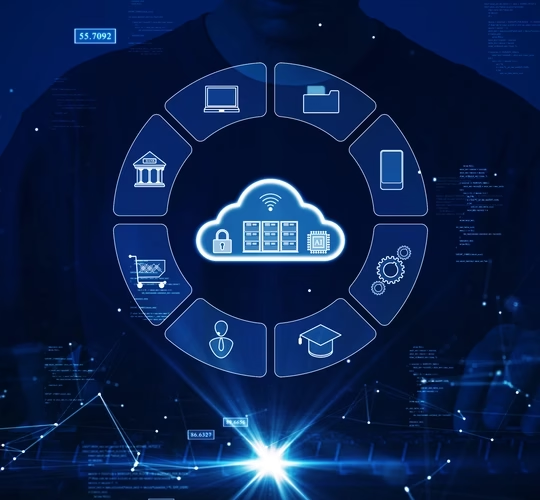


Round-the-clock GCP monitoring and optimization ensures your compute, storage, and networking resources operate at peak efficiency. Automated alerting detects anomalies before they escalate into outages. Real-time dashboards provide visibility into resource health and utilization patterns.

Structured GCP incident management workflows minimize mean-time-to-resolution for production disruptions. Dedicated response teams triage, diagnose, and resolve issues within defined SLA windows. Post-incident reviews identify root causes and preventive measures.

Regular GCP security patching and updates protect your environment from emerging vulnerabilities and compliance gaps. Scheduled maintenance windows minimize business disruption while keeping operating systems, containers, and managed services current with latest security standards.

Strategic Google Cloud cost optimization services analyze spend patterns, eliminate waste, and implement committed-use discounts. FinOps-driven reviews identify idle resources, oversized instances, and missed discount opportunities to deliver measurable savings every billing cycle.

Comprehensive Google Cloud disaster recovery support establishes failover architectures, automated backup verification, and recovery runbooks. Multi-region replication strategies ensure business continuity with defined RPO and RTO targets aligned to your operational requirements.

Holistic GCP environment management covers project organization, IAM governance, network configuration, and resource lifecycle policies. Comprehensive Google Cloud infrastructure management through standardized tagging and labeling frameworks enables accurate cost allocation across departments, teams, and applications.

Reliable Google Cloud backup and recovery services protect critical data through automated snapshot scheduling, cross-region replication, and periodic restore testing. Encryption at rest and in transit ensures data integrity throughout every backup lifecycle stage.

Targeted GCP performance tuning identifies bottlenecks across compute, database, and networking layers. Load testing, query optimization, and autoscaling refinement translate directly into faster response times, improved throughput, and better end-user experiences.

Tailored Google Cloud compliance management services align your environment with HIPAA, SOC 2, GDPR, PCI-DSS, and ISO 27001 requirements. Audit trail configuration, access controls, and policy enforcement reduce regulatory risk across regulated industries.
Layered GCP managed security services deploy threat detection, vulnerability scanning, and intrusion prevention across your cloud estate. Security Command Center integration provides centralized visibility into misconfigurations, policy violations, and active threats.

Scheduled Google Cloud proactive maintenance activities including capacity planning, configuration audits, and architecture reviews keep your infrastructure aligned with evolving business demands. Preventive action reduces emergency interventions and unplanned spend.

Data-driven GCP resource optimization rightsizes instances, consolidates underutilized assets, and recommends sustained-use or committed-use discounts. Continuous review cycles ensure resource allocation stays matched to actual workload requirements across all environments.

Rigorous Google Cloud SLA management defines response times, escalation paths, and resolution benchmarks for every support tier. Transparent reporting against agreed service levels keeps accountability visible and operational standards consistently high.

Applied GCP site reliability engineering practices embed error budgets, service-level objectives, and automated remediation into your operations. SRE-driven toil reduction frees your engineering teams to focus on product innovation rather than firefighting.

Structured Google Cloud FinOps services build financial accountability into your cloud operations. Cross-functional collaboration between engineering, finance, and procurement teams drives informed spending decisions backed by granular usage analytics.

Full-spectrum managed GCP infrastructure services handle compute provisioning, network management, storage administration, and database operations. Your internal teams stay focused on core business initiatives while certified specialists maintain operational excellence.

Banks and financial institutions operate under strict uptime mandates and regulatory scrutiny. Google Cloud support and maintenance services ensure transaction processing systems, fraud detection platforms, and customer-facing applications remain available around the clock. GCP managed security services and compliance management protect sensitive financial data while meeting SOC 2 and PCI-DSS audit requirements.

Healthcare providers managing electronic health records, telemedicine platforms, and clinical research workloads require zero-tolerance reliability. GCP maintenance services deliver continuous monitoring, HIPAA-aligned security controls, and disaster recovery architectures. Proactive patching and vulnerability management safeguard patient data across distributed cloud environments.

Retail businesses experience dramatic traffic fluctuations during seasonal events and promotional campaigns. GCP performance tuning and resource optimization ensure storefronts remain responsive during peak demand. Google Cloud cost optimization services prevent overspending during low-traffic periods while maintaining capacity for instant scale-up.

Manufacturers leveraging IoT sensors, predictive maintenance analytics, and supply chain visibility tools depend on stable cloud infrastructure. GCP environment management standardizes configurations across factory-connected systems. Google Cloud backup and recovery services protect production data and operational continuity across global facilities.

Software companies hosting multi-tenant platforms on Google Cloud require continuous uptime, rapid incident resolution, and performance guarantees for their end users. GCP site reliability engineering practices embed observability and automated remediation. Google Cloud SLA management ensures external commitments are backed by robust internal operations.

Universities and EdTech platforms serving millions of concurrent learners need infrastructure that scales dynamically during enrollment peaks and examination windows. GCP monitoring and optimization maintains platform stability. Google Cloud proactive maintenance schedules around academic calendars to minimize learning disruption.

Streaming services, content delivery networks, and gaming platforms demand ultra-low latency and consistent throughput. GCP performance tuning optimizes media processing pipelines and CDN configurations. Google Cloud disaster recovery support protects content libraries and user engagement data across multi-region deployments.
Fleet management platforms, route optimization engines, and real-time tracking systems process continuous data streams. Managed GCP infrastructure services maintain uptime for mission-critical logistics applications. GCP incident management ensures rapid resolution when disruptions threaten delivery commitments and customer satisfaction.

Energy companies operating SCADA systems, grid management platforms, and renewable monitoring dashboards require highly available and secure cloud environments. Google Cloud compliance management services address NERC CIP and industry-specific regulatory frameworks. GCP security patching and updates protect operational technology infrastructure.

Government agencies modernizing citizen services, permitting systems, and data analytics platforms require FedRAMP-aligned cloud operations. Google Cloud 24/7 monitoring services ensure public-facing applications remain accessible. GCP managed security services implement defense-in-depth strategies across classified and unclassified workloads.
Banks and financial institutions operate under strict uptime mandates and regulatory scrutiny. Google Cloud support and maintenance services ensure transaction processing systems, fraud detection platforms, and customer-facing applications remain available around the clock. GCP managed security services and compliance management protect sensitive financial data while meeting SOC 2 and PCI-DSS audit requirements.
Healthcare providers managing electronic health records, telemedicine platforms, and clinical research workloads require zero-tolerance reliability. GCP maintenance services deliver continuous monitoring, HIPAA-aligned security controls, and disaster recovery architectures. Proactive patching and vulnerability management safeguard patient data across distributed cloud environments.
Certified specialists delivering measurable operational improvements through deep Google Cloud platform knowledge and proven support methodologies.
Our cloud operations practice applies SRE principles including error budgets, service-level objectives, and automated incident response to GCP environments. Teams use Cloud Monitoring, Cloud Logging, and custom dashboards to maintain continuous observability across compute, storage, and networking layers.
Dedicated security engineers configure Security Command Center, Chronicle SIEM, and Cloud Armor to protect your GCP estate. Compliance automation maps controls to HIPAA, SOC 2, GDPR, PCI-DSS, and ISO 27001 frameworks through infrastructure-as-code policy enforcement and continuous audit trail generation.
FinOps-certified analysts implement billing account hierarchies, budget alerts, and committed-use discount strategies within Google Cloud. Custom cost dashboards powered by BigQuery and Looker deliver actionable spend visibility that drives cross-functional accountability between engineering and finance teams.
Infrastructure engineers build and maintain Terraform, Deployment Manager, and Config Connector pipelines for repeatable GCP provisioning. GitOps workflows through Cloud Build and Cloud Deploy ensure configuration consistency across development, staging, and production environments.
Certified database administrators manage Cloud SQL, Cloud Spanner, AlloyDB, Firestore, and Bigtable deployments with focus on query performance, replication reliability, and backup integrity. Proactive index tuning and connection pooling optimization maintain sub-millisecond response times under production load.
Recovery architects design multi-region failover topologies, automated backup verification pipelines, and documented runbook procedures for your GCP workloads. Regular disaster recovery drills validate RPO and RTO targets, ensuring organizational readiness for unplanned disruptions.
TAV Tech Solutions combines certified cloud expertise with operational discipline to deliver Google Cloud support that drives measurable business outcomes.
TAV Tech Solutions has earned several awards and recognitions for our contribution to the industry


No posts found.
This guide helps technology leaders, IT directors, and procurement professionals evaluate, select, and implement the right Google Cloud support and maintenance model for their organization.
Google Cloud offers multiple native support tiers ranging from basic documentation access to premium plans with 15-minute P1 response times. However, native support alone rarely covers the full operational needs of enterprise environments. Third-party GCP support services bridge this gap by providing dedicated engineers, proactive monitoring, and hands-on remediation that go beyond ticket-based assistance. When evaluating support options, assess your workload criticality, team capacity, and incident frequency. Production environments processing customer transactions or sensitive data typically require 24/7 coverage with defined escalation paths. Development and staging environments may only need business-hours support. Match your Google Cloud SLA management requirements to the actual risk profile of each workload tier.
Building an internal GCP operations team requires hiring certified engineers, investing in monitoring tooling, and establishing on-call rotations. For many organizations, the cost of recruiting, retaining, and continuously training cloud specialists exceeds the investment in managed GCP infrastructure services. The decision framework should consider total cost of ownership across salaries, benefits, tooling licenses, and opportunity cost of slower incident response. Google Cloud technical support outsourcing provides immediate access to experienced teams without recruitment timelines. Organizations maintaining fewer than fifty GCP projects often find outsourced models more cost-effective. Larger enterprises frequently adopt hybrid models where internal teams handle architecture decisions while external specialists manage day-to-day GCP cloud operations support.
Unmanaged cloud spend grows unpredictably as teams provision resources without centralized oversight. Effective Google Cloud FinOps services establish governance structures that connect engineering consumption decisions to financial accountability. Start by implementing billing account hierarchies that segment spend by business unit, environment, and application. Budget alerts configured at 50%, 75%, and 90% thresholds provide early warning before overruns occur. Committed-use discounts for predictable workloads and sustained-use discounts for steady-state resources reduce unit costs by 20-57%. Regular rightsizing reviews through Google Cloud cost optimization services identify instances running below 40% utilization. Automated recommendations from the GCP Recommender API flag specific downsizing opportunities with projected savings.
Every organization running production workloads on Google Cloud needs a documented disaster recovery plan with tested failover procedures. Google Cloud disaster recovery support starts with classifying workloads by business impact and assigning appropriate RPO and RTO targets. Tier-one workloads supporting revenue-generating applications typically require multi-region active-active deployments with RPO near zero and RTO under fifteen minutes. Tier-two workloads may tolerate warm standby configurations with RPO measured in hours. Google Cloud backup and recovery services should include automated snapshot scheduling, cross-region replication, and quarterly restoration drills that validate end-to-end recovery capability.
Cloud security is a shared responsibility where Google secures the underlying infrastructure and your organization secures configurations, access controls, and data. GCP managed security services close the operational gap by continuously scanning for misconfigurations, enforcing least-privilege access policies, and monitoring for anomalous behavior. Organizations in regulated industries need Google Cloud compliance management services that map technical controls to specific regulatory requirements. Pre-configured compliance dashboards track control effectiveness in real time rather than relying on periodic manual audits. Security posture management tools like Security Command Center Premium provide vulnerability findings, threat detection, and compliance reports in a unified console.
Quantifying the return on your GCP support investment requires tracking operational metrics alongside business outcomes. Key performance indicators include mean-time-to-detect, mean-time-to-resolve, change failure rate, and deployment frequency. Operational metrics should connect directly to business impact measures such as revenue protected through uptime maintenance, cost savings achieved through GCP resource optimization, and security incidents prevented through proactive patching. Monthly service reports comparing actual performance against GCP support SLA targets provide the accountability framework. Quarterly business reviews should present trend analysis showing improvement trajectories that justify continued investment in professional support services.
Services typically encompass 24/7 infrastructure monitoring, incident management, security patching, performance tuning, cost optimization, backup management, compliance reporting, and proactive maintenance activities. The exact scope depends on your chosen engagement tier and workload requirements.
Response times follow defined SLA windows. P1 critical incidents receive acknowledgment within 15 minutes and active troubleshooting within 30 minutes. P2 high-priority issues receive response within 1 hour. All GCP incident management timelines are documented in your service agreement.
While our primary specialization is Google Cloud, our teams have experience supporting hybrid architectures that span GCP alongside other cloud providers. Cross-cloud visibility and unified monitoring dashboards ensure consistent operational standards regardless of platform.
Our engineers hold Google Cloud Professional certifications across Cloud Architect, Cloud DevOps Engineer, Cloud Security Engineer, Cloud Network Engineer, and Data Engineer tracks. Teams maintain active certification status through continuous recertification programs.
Our FinOps analysts conduct billing reviews identifying idle resources, oversized instances, and missed discount opportunities. Committed-use discount procurement, sustained-use tracking, and automated rightsizing recommendations typically achieve 20-40% cost reductions within the first quarter.
Rolling update strategies, blue-green deployments, and maintenance window scheduling minimize service disruption during patching cycles. GCP security patching and updates are planned around your traffic patterns to ensure business continuity throughout maintenance activities.
We serve financial services, healthcare, retail, manufacturing, SaaS, education, media, logistics, energy, and government sectors. Each industry engagement applies domain-specific compliance controls and operational practices relevant to the regulatory environment.
Disaster recovery architectures include multi-region replication, automated backup verification, and documented recovery runbooks. Regular failover drills validate RPO and RTO targets. Google Cloud disaster recovery support ensures your organization can resume operations within defined recovery windows.
Standard onboarding completes within two to four weeks depending on environment complexity. The process includes Google Cloud infrastructure management discovery, monitoring agent deployment, runbook documentation, and knowledge transfer sessions before transitioning to steady-state operations.
Engagement models range from fully managed GCP infrastructure services to co-managed arrangements where your internal team retains architecture ownership. Project-based support for specific initiatives and staff augmentation models are also available.
Compliance frameworks are embedded into infrastructure automation using policy-as-code. Google Cloud compliance management services map controls to HIPAA, SOC 2, GDPR, PCI-DSS, and ISO 27001 requirements with continuous monitoring and automated audit evidence collection.
Primary tooling includes Cloud Monitoring, Cloud Logging, Cloud Trace, and Security Command Center integrated with third-party platforms like Datadog, Grafana, and PagerDuty. Custom dashboards provide workload-specific visibility aligned to your operational priorities.
Our Google Cloud FinOps services establish governance structures including billing hierarchies, budget alerts, chargeback models, and cross-functional review cadences. FinOps maturity assessments identify gaps and create roadmaps for continuous improvement in cloud financial management.
GCP performance tuning starts with baseline assessment across compute, networking, database, and application layers. Load testing identifies bottlenecks while autoscaling configuration, query optimization, and CDN tuning deliver measurable latency and throughput improvements.
Native Google support provides break-fix assistance through ticket-based interaction. Managed GCP infrastructure services provide dedicated engineering teams, proactive monitoring, hands-on remediation, cost optimization, and strategic guidance as an extension of your operations.
Google Cloud SLA management commitments include defined response times by priority level, monthly availability targets, and resolution benchmarks. Service credit mechanisms apply when agreed performance thresholds are not met, ensuring financial accountability.
Our GCP site reliability engineering practice helps organizations implement error budgets, service-level objectives, and incident management frameworks. Toil reduction programs automate repetitive operational tasks, freeing engineering capacity for feature development.
Google Cloud technical support outsourcing transitions follow a structured methodology covering discovery, documentation, parallel operation, and full handover. Knowledge transfer sessions and shared runbooks ensure continuity during the transition period.
Monthly reports cover availability metrics, incident summaries, cost trends, security posture scores, and capacity forecasts. Executive dashboards visualize key performance indicators. Quarterly business reviews present strategic recommendations aligned to your growth objectives.
Continuous GCP resource optimization uses automated recommendation engines combined with manual review cycles. Weekly rightsizing scans, monthly discount utilization reviews, and quarterly architecture assessments ensure resource allocation stays aligned with actual workload demands.
Let’s connect and build innovative software solutions to unlock new revenue-earning opportunities for your venture


We would love to hear from you

5th Floor, DLF Two Horizon Centre, DLF Phase 5, Gurugram, HR 122002


